job interview

Your Resume Got You the Interview. Your Personal Brand Will Get You the Job

Melissa Maughn is a Personal Brand and Messaging Strategist with over 25 years of corporate experience and 5 years of brand strategy expertise. She is the creator of The Identity Map, a five-layer personal brand framework, and the host of The Brand Bridge podcast. Melissa lives in Montreal but serves clients internationally. She spoke with Relevant Resume about how to develop your personal brand and what it means to have one.


I was always a weird kid, full of wonder and imagination. My heart's desire was to be an actress.

So you can understand my shock and horror when I had to do the "sensible" thing and get a real job. Or as we say in a Caribbean household, a "big job," meaning it paid well and looked good on paper.

I thought it would be a struggle. But there I was spending over 25 years in the corporate world working in banking, recruitment, and project management. And I actually enjoyed it.

I know what it is like to navigate office dynamics, work across teams, and try to figure out where you fit in a culture that was not always designed with you in mind. And after 5 years working specifically in brand strategy, I can tell you with confidence: the people who stand out aren’t the ones who are the most qualified, but the ones who know who they are.

If you’re job searching, considering a change, or just feeling like something is off in your current role, this is worth your attention. Most people think personal branding is about LinkedIn profiles and elevator pitches. What it’s actually about is clarity on who you are, which then shapes how you show up, how you communicate, and how others experience you.

Your identity should never be wrapped up in what you do. Because if what you do ever changes, and in today's market it most likely will, who are you then?

I have watched people navigate layoffs, career pivots, and re-entries into the workforce after time away, whether that was raising kids, caring for family, or just needing a reset. The ones who struggle most are not the ones without skills. They are the ones who lost the thread of who they are outside of their job title.

So let's talk about the three things that changed everything for me, and that I believe will change things for you too: clarity, confidence, and connection.

Clarity: Knowing Who You Are Before Anyone Else Tells You 

Clarity is not about having a perfect answer to "tell me about yourself." It is about understanding your personality, your values, your story, and how all of that connects to the way you work and what you bring to a team.

Here is a simple example. If your natural energy is warm and enthusiastic, but your colleague genuinely needs quiet time before she can engage in the morning, clarity about who you are helps you adapt without losing yourself. You are not dimming your light. You are being intentional. And that intentionality is how you become known as someone with emotional intelligence and self-awareness. Those are not soft skills. They are leadership qualities.

We are taught from a young age to fit a mold. Especially as women, there can be pressure to be palatable, to not take up too much space, or, on the other side, to be so fiercely independent that asking for help feels like weakness. But we are built for community. We are meant to work alongside people whose gifts complement ours. Clarity about who you are is what makes that possible without losing yourself in the process.

Confidence: Showing Up Consistently as Yourself

Once you know who you are, confidence becomes less about performance and more about consistency.

Like I always say, a copy is never as good as the original. Remember that.

When you are clear on your identity, you stop scanning the room to see how others are doing it. You stop performing who you think the interviewer wants to see. You show up as the person who actually has something to offer.

Something I chose to do in my corporate years was to be present. Not just physically in the room, but actually there. Engaged. Because your presence is a choice, whether you are in a job interview, a team meeting, or a performance review. Your energy is information, and your attitude is data. The way you show up either confirms or contradicts the brand you are building.

Here is the question I love to ask: On a Monday morning, are people running toward you or away from you?

That is your personal brand at work.

Connection: How Your Brand Builds Bridges, Not Walls 

When you know who you are and you show up with confidence, you naturally start building the kind of trust that makes people remember you. You are not threatened by someone else's strengths because you know what yours are. You stop competing for credit because you understand your contribution. You become the kind of peer who makes everyone around them better.

And then you become a leader, even if your job title says otherwise. Because leadership is not a title. It is the way you show up for the people around you.

Try This: Draft Your Personal Brand Statement

Before your next interview, application, or networking conversation, try this. It takes about 2 minutes.

"I am someone who [a strength you carry naturally]. I use that to [how it helps others]. So that [the result it creates]. Without [the negative it removes or prevents]."

For example: "I am someone who sees the potential in people. I use that to build bridges across teams, so that our collective impact is greater than any one of us alone."

It's not just a nice thing to say about yourself. That is your personal brand in action.

One Last Thing

If I could go back and tell myself one thing, it would be this: Your story, your personality, and what you value are your qualifications. Not just what is on your resume, but the experiences that shaped you and the way you have learned to show up for the people around you.

Your resume tells people what you have done. Your personal brand tells them who you are. And the right opportunity is waiting for someone who knows the difference.

5 Ways to Manage Job Interview Anxiety During the Job Hunt

Adina Solomon, Founder of Relevant Resume

My name is Adina Solomon, and I’m the founder of Relevant Resume. I’ve been writing resumes, cover letters, and LinkedIn profiles since 2018. I also worked as a journalist.

I remember one of my first job interviews after graduating university. My nerves got so bad, they started affecting my speech. There were a few points where my words were falling over each other and my voice was shaking. It’s definitely one of those moments I’ve replayed a lot in my mind.

I’ve come a long way since that interview. But now I know that I have nothing to be embarrassed about. I’m not alone in suffering from job interview nerves. In fact, 93% of people in the US have experienced anxiety related to interviews, according to employment screening company JDP.

Job interviews are a balancing act. You need to show your personality, your interest in the job and organization, and your experience. And that needs to happen in a relatively short conversation (or more often a series of conversations). No wonder even the most experienced people can get nervous.

I want to share 5 techniques to manage job interview anxiety. That way, you can stay calmer and more focused during your next interview.

Practice Interviewing

The more you practice something, the more confidence you have. This is true for everything from pickleball to writing to interviewing.

Research the company and job. Take a few minutes and write down the most likely questions that will appear during an interview. This will depend somewhat on your industry and job, but there are common questions that come up no matter what:

  • Tell me about yourself.

  • What’s your biggest strength? Your biggest weakness?

  • Why do you want to work here?

  • How do you handle criticism?

  • Do you have any questions for us? (Yes, you do.)

Don’t let these questions catch you off guard. Online resources such as Harvard Business School go over how to formulate memorable answers. Think about your answers in advance, including what anecdotes to use. Then write down notes on how you’ll respond to these common interview questions.

Don’t stop at the writing stage. Practice those answers out loud. Do it by yourself or with a friend or family member. Some people record themselves and then watch it back. For the best practice, go to professionals such as Relevant Resume, where we offer non-judgemental mock job interviews followed by constructive feedback.

Whatever you do, make sure to practice. Solely relying on improvisation can often lead to anxiety before and during the interview. Minimize this by preparing your answers.

Take Time Before a Job Interview

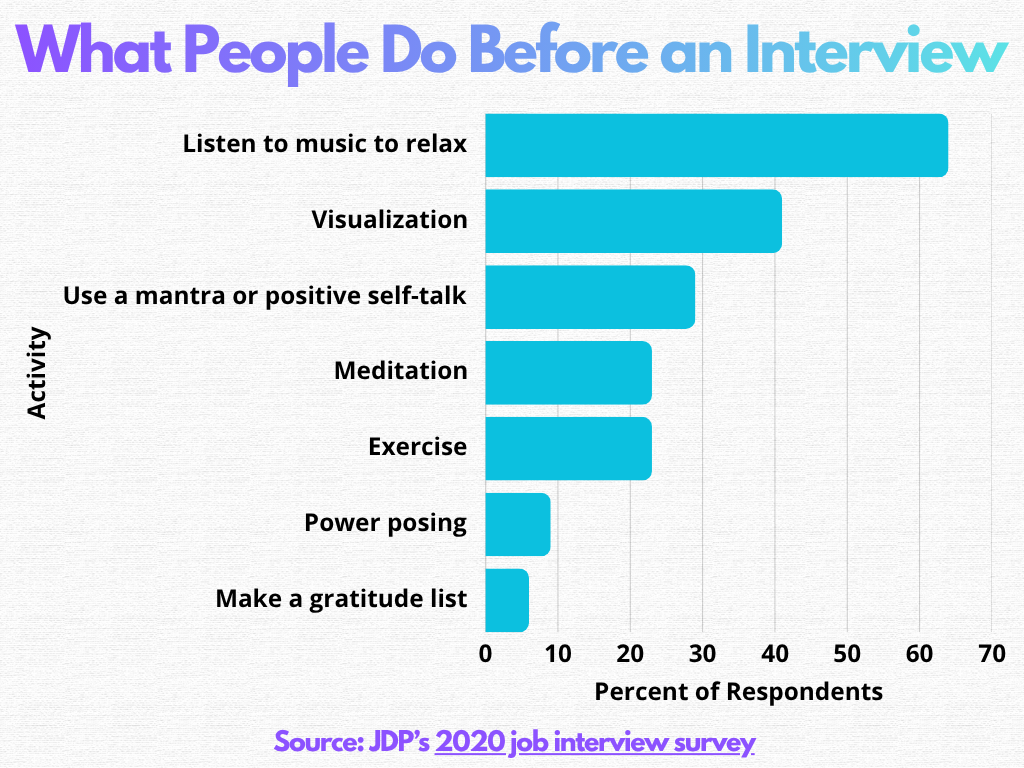
Even if it’s just for a few minutes, set aside some time before your interview to relax. Activities that people do include:

  • Listening to music

  • Meditating

  • Taking deep breaths

  • Exercising

  • Visualizing positive outcomes

  • Doing positive self-talk

Taking some time for yourself, rather than jumping straight into a job interview, can help you calm down. This makes for a less anxious interviewing experience.

I have anxiety. To relax, my go-to strategy is listening to music while deeply breathing. Usually I lie down and close my eyes during this, but sometimes my anxiety takes the form of fidgeting. That’s when I stand up and do stretches.

I also like to queue up everything I need for the job interview: the link for the meeting invite, my notes, a glass of water, and a notebook and pen so I can jot down ideas and questions during the interview. Having everything at hand soothes my mind.

Find what works for you. Mental preparation is a powerful tool to manage anxiety when interviewing.

Reserving extra time before an interview can get complicated if you’re job hunting while also working another role. But if you can set aside even 5-10 minutes to ground yourself, it has a positive effect on interview anxiety.

Speak Slowly

It happens to just about everyone: You’re in the middle of the job interview and anxiety starts bubbling up. There are ways to manage this situation as it’s happening.

Take a breath and speak slower. It’s easy to start talking quickly when we’re nervous. You could even take a pause and ask the interviewer if your answer needs any clarification. After all, job interviews are supposed to be conversations. What seems clear to one interviewer might not be to the next.

If needed, repeat the question that the interviewer asked before you launch into an answer. That can give you an opportunity to slow down and think of your response.

These quick grounding exercises could help steady your nerves during the interview.

Be Honest

Another strategy is to be honest about your anxiety. It doesn’t need to be a secret. It’s likely that your interviewer has gone through the same thing before and will be able to relate.

If you stumble over your words or your voice cracks, you can talk about it: “I’m a bit nervous because I’m excited about this interview.”

This kind of acknowledgement humanizes you. Most interviewers understand that job interviews can be nerve-wracking and appreciate that you’re being honest and self-aware.

Take a Moment After the Interview

I usually need to take a breather after an interview ends. Once I’m alone, I sit, draw a few breaths, and maybe watch a short video on YouTube to make me laugh. (I’m a big fan of skit comedy.) These activities break my mental tension.

Those of us with anxiety can often still feel it pulsing through our bodies even after an interview is over. So self-care is key. Do whatever activity makes you calmer and helps you come down from the interview nerves.

If you want to feel more prepared for your next job interview, we’re happy to help. Book a mock interview and get an hour to practice with a non-judgemental professional.