
My name is Adina Solomon, and I’m the founder of Relevant Resume. I’ve been writing resumes, cover letters, and LinkedIn profiles since 2018. I also worked as a journalist.
Not long ago, a client came to me with a resume that made me raise my eyebrows. Their resume had a job that they had last worked in 1998, almost 3 decades ago.
I get it. It’s easy to make small updates to your resume as the years go on without evaluating the entire document. Life is busy and a resume can fall by the wayside. But the sticking point with this client was they refused to remove their old job.
“I understand it was an important job for the beginning of your career, but most of the skills you learned have changed since then,” I said. “It was a tech job. Technology is so much different now and you’ve had plenty of experience since then.”
My words didn’t help. I gave my professional opinion but at the end of the day, the choice is up to the client. They insisted on keeping the job on their resume.
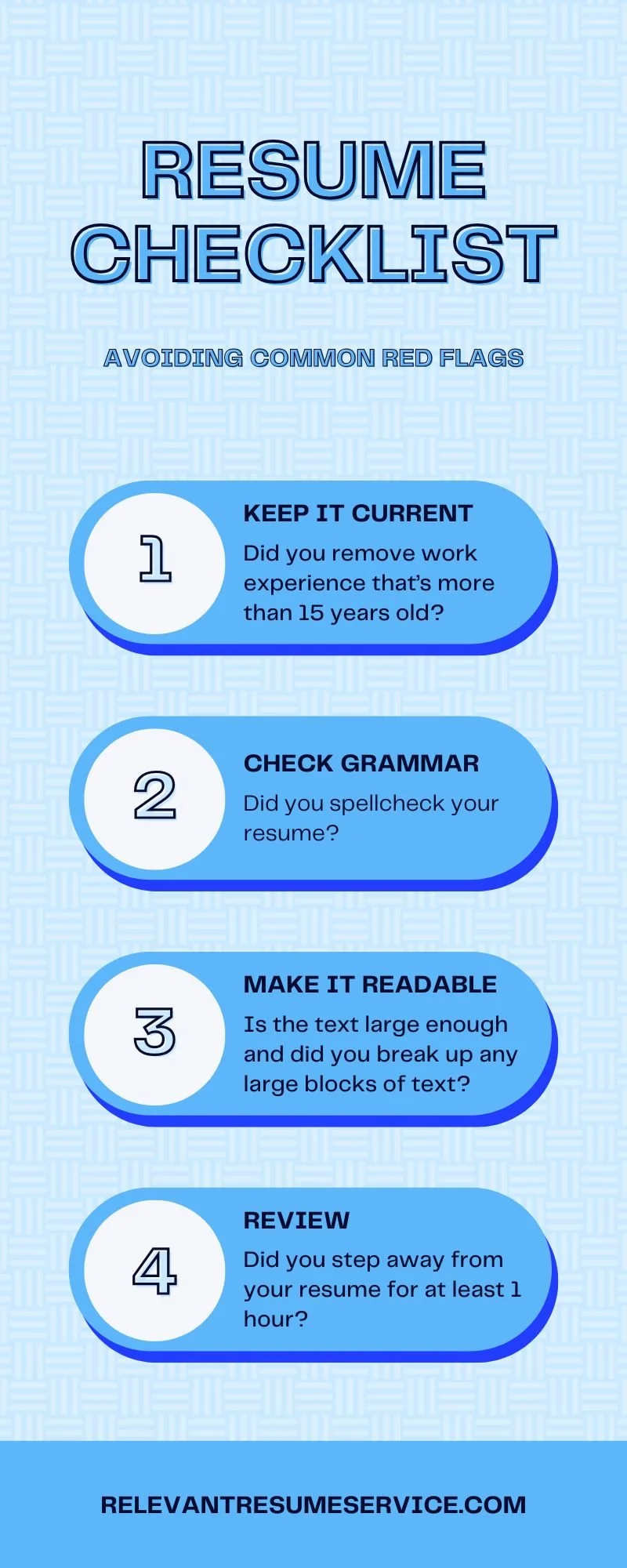
These seemingly small decisions add up. It’s why as you set out to write your resume, you should watch out for these 5 red flags.
1. Keeping jobs on your resume that are too far in the past
This is a mistake made by so many people, including the one with a job from 1998. The rule of thumb is resumes should extend back 10-15 years, give or take a few years.
If you start including jobs that were 25-30+ years ago, you run a higher risk of age discrimination during a job hunt. Almost three-quarters of older Americans believe their age could be a barrier to getting hired, according to AARP. I definitely hear that concern from older clients. Keeping your resume to your latest experience helps combat that.
Even if you’re not worried about ageism, removing older jobs creates space for you to talk about your most recent accomplishments. Think about your resume as the valuable real estate that it is. Don’t clutter it with info that isn’t serving you well.
An exception to removing older experience is college degrees. If you have any, just remove your graduation date when more than a few years have passed.
2. Making grammar or informational mistakes on your resume
When I was in high school, I became known for editing my friends’ essays. I enjoyed it. There’s something satisfying about making things correct and concise. It’s no wonder I later became a journalist and then a resume writer.
So the editor in me shudders when people apply with resumes that contain mistakes. I’ve seen grammatical errors that spellcheck could have caught, misspelled company names, run-on sentences, and wrongly linked websites.
Applying to a job with a resume that contains grammatical errors looks sloppy and doesn’t make you appear as the attentive worker that you are.
After you’ve written your resume, take a break from it for at least an hour and then come back with fresh eyes. How does it read? Is everything spelled correctly? Are the facts and figures you cited accurate? Do any links work? This exercise ensures that minor mistakes won’t hold you back.
3. Having a job or career objective on your resume
Like I said before, your resume is valuable real estate and an objective isn’t doing you any favors.
On a basic level, your objective for having a job is to make money. We all know that. And perhaps you have other goals too, such as growing in your career. But an objective statement saying those things is ineffective and doesn’t tell the hiring manager much about you.
Instead you can write a professional summary that appears at the top of your resume after your name and contact info. This is just a few lines that summarizes your experience and skills. Think about what you can offer to a potential employer. It’s also a good spot to include some keywords for your industry.
4. Formatting your resume so it’s difficult to read
I probably spend more time than anyone reading a client’s resume. I look through career, academic, and any other experience with a sharp eye. But a recruiter won’t spend that long. On average, recruiters read a resume for 30 seconds before deciding if you’re a good fit for a job or not.
That means you want your resume to be as easy as possible to read so it isn’t immediately tossed aside.
I don’t want to see graphics. Use a neutral font like Arial or Times New Roman. Don’t make your resume a 9-point font to fit everything into one page; not everyone will be able to read that. Work experience should be in chronological order with the most recent job(s) at the top of your employment section.
These are simple things to do, but they can make all the difference in how easy it is for a hiring manager to read your resume.
5. Writing large blocks of text
Sometimes I open a client’s resume for the first time and even I have trouble reading it. That doesn’t bode well for when a recruiter inevitably opens it.
One of the top red flags to avoid is writing large blocks of text. Though it’s important to show accomplishments for each of your jobs listed, format them as bullet points instead of one large paragraph. Bullet points are much easier to scan quickly than a block of text.
Each bullet point should be 1-2 lines long and not use extraneous language (like too many adjectives) that can clutter a sentence. Also decide if you want to end each bullet point with a period or not. Either choice is fine, but it needs to remain consistent throughout your resume.
These 5 red flags and how to avoid them will help you create the best resume possible. If you want more personalized guidance, book a consultation today.